Agentic Trading Hub
An autonomous quant trading platform where AI agents select strategies, manage risk, and execute trades on Hyperliquid — with 10 deterministic strategies, multi-agent consensus, and live sentiment analysis.
Trading strategies
10
Breakout, mean reversion, funding arbitrage, liquidation cascade, entropy regime, and more.
AI agents
3 layers
Trade Planner, Analyst reviewer, and multi-model Consensus Engine with weighted voting.
Features engineered
50+
Trend, volume, volatility, funding, orderflow, and stochastic model features across 5 timeframes.
Risk controls
12 gates
Notional caps, leverage limits, drawdown throttling, cooldown windows, slippage checks, and more.
The Problem
What this project had to solve
Manual trading is slow, emotional, and inconsistent. Most quant systems are either fully deterministic (missing context) or fully AI-driven (hallucination risk). Agentic Trading Hub combines both: deterministic signals for precision, AI oversight for context, and hard risk gates for safety.
Agentic Trading Hub was built to automate the full trading lifecycle: from market data ingestion and feature engineering, through AI-driven strategy selection, to risk-gated execution on Hyperliquid perpetuals. The system combines deterministic quant signals with LLM-powered oversight.
The backend is a FastAPI async service with PostgreSQL, Redis, Qdrant vector memory, and Temporal for durable workflow orchestration. The frontend is a React 18 operator console built with Vite, TanStack Query, and Tailwind CSS. Ten trading strategies cover breakouts, mean reversion, funding arbitrage, liquidation cascades, and entropy regime detection.
What makes the system distinctive is the multi-layer AI architecture: a Trade Planner agent selects strategies and sizes positions, an Analyst agent reviews decisions for risk flags, and a Consensus Engine aggregates votes from multiple LLMs with capability-weighted scoring. All decisions flow through a hard risk engine and safety controller before reaching the Hyperliquid SDK for execution.
What changed
Operators get a unified platform where strategy deployment, AI oversight, risk management, and exchange execution work as a single pipeline — with full observability into every decision, trade, and P&L metric.
Why it was hard
Combining deterministic quant strategies with non-deterministic LLM agents in a latency-sensitive trading loop required careful separation of concerns: signals must be reproducible, AI adjustments must be bounded, and execution must be atomic with reconciliation against live exchange state.
Constraints
- Execution must be atomic and reconcilable — positions on Hyperliquid must match internal state at all times.
- LLM costs must be budget-capped per deployment with circuit breakers and fallback chains.
- Strategy signals must be deterministic and reproducible — AI can adjust sizing but cannot override signal logic.
My role
- Designed the full architecture: orchestration pipeline, agent hierarchy, risk engine, execution layer.
- Built 10 trading strategies with multi-timeframe feature engineering (50+ features).
- Implemented multi-agent consensus with capability-weighted voting across OpenRouter, Mistral, and Ollama.
- Integrated Hyperliquid SDK for live order placement, position tracking, and WebSocket orderflow.
- Built the operator console (React) for deployment management, trade monitoring, and agent analytics.
Proof
What the product actually looks like
Real screens from the product — each one supports a specific argument about clarity, control, or observability.
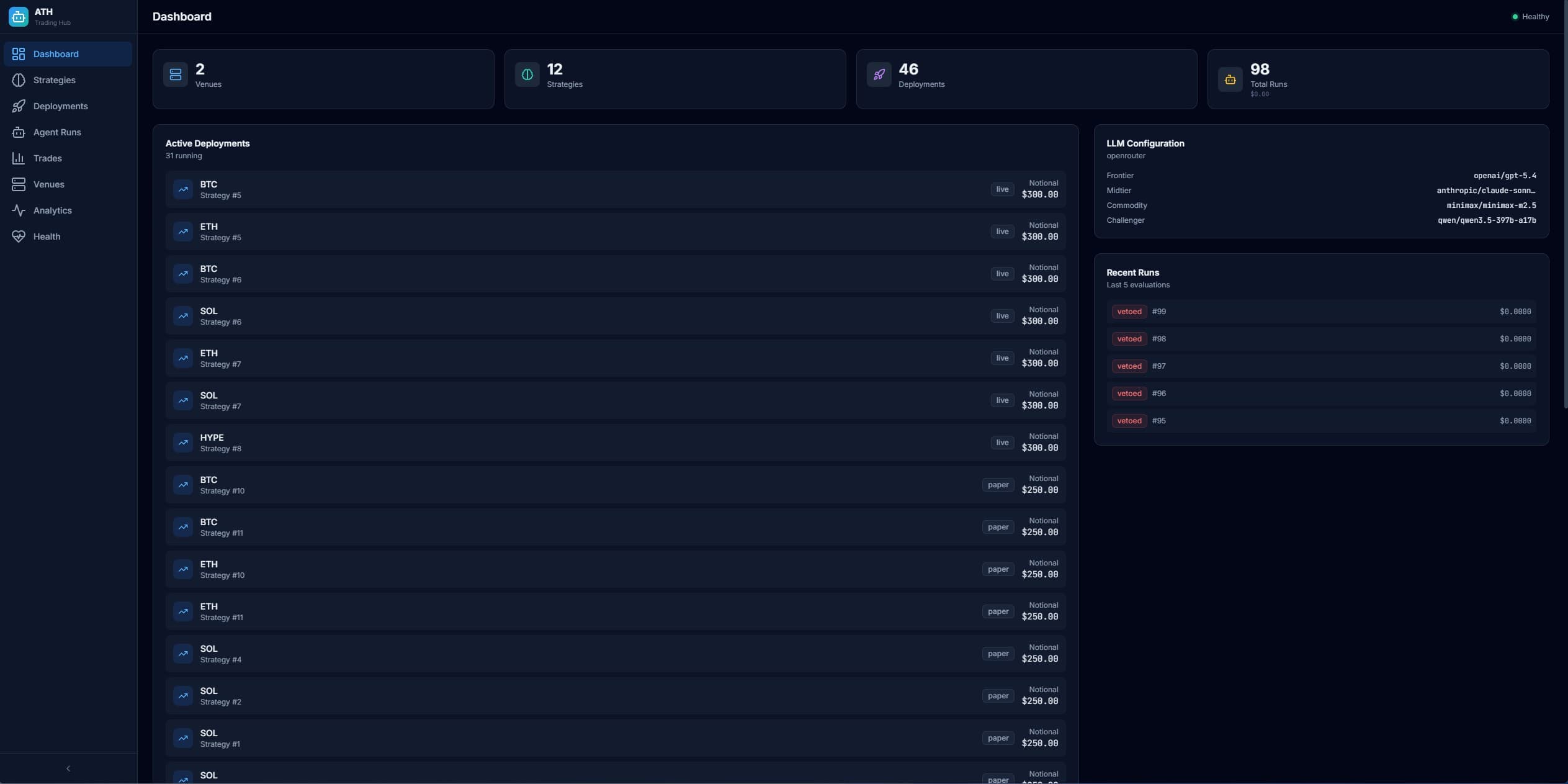
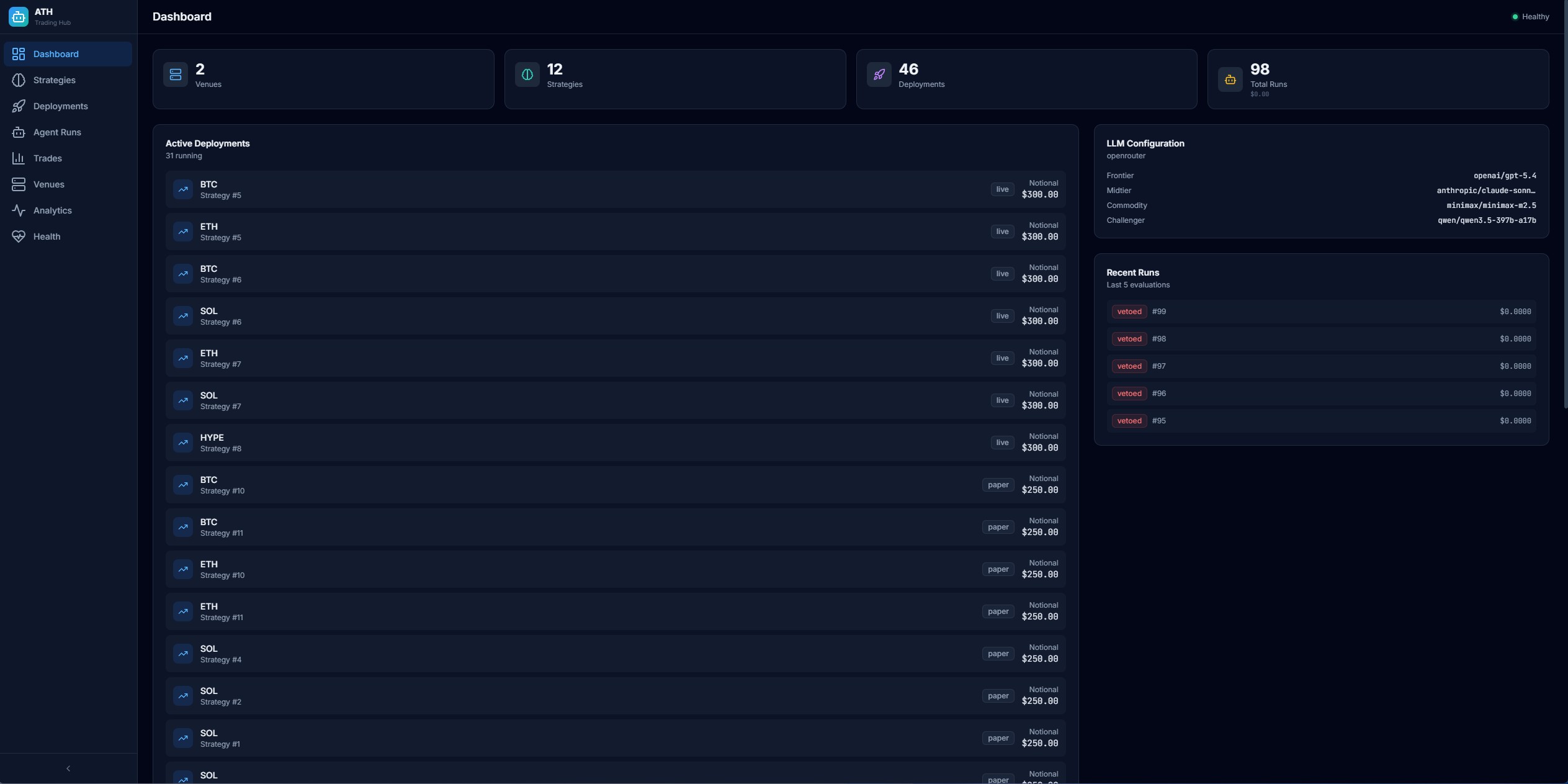 Command CenterClick to view full size
Operator Dashboard
Real-time overview of deployments, P&L, agent runs, and system health in a single operational surface.
Designed for operators, not traders — every metric serves a decision.
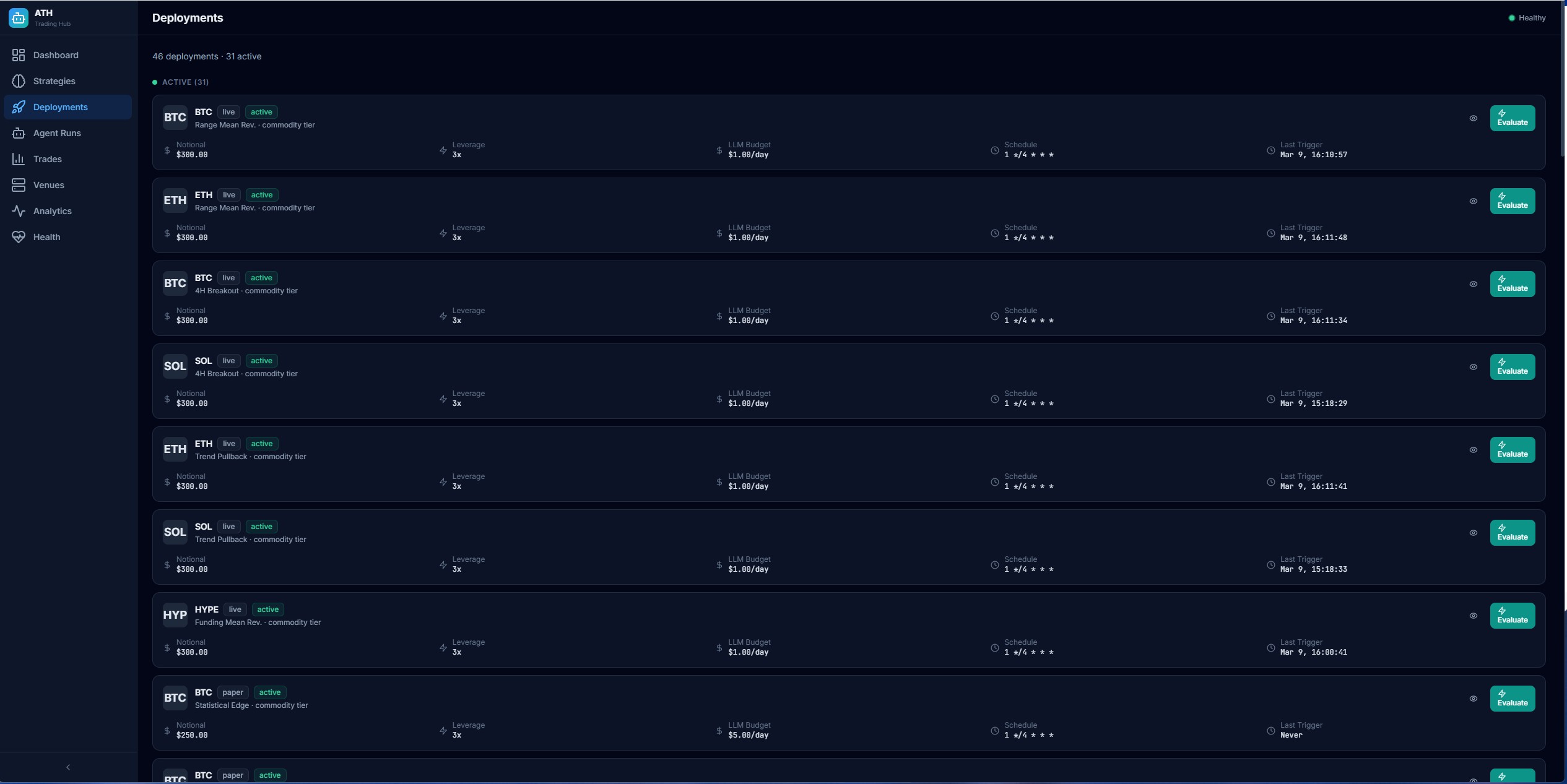 Deployment EngineClick to view full size
Strategy Deployments
Configure and deploy trading strategies with venue, budget, schedule, and risk parameters.
Each deployment is an isolated unit with its own budget, schedule, and risk profile.
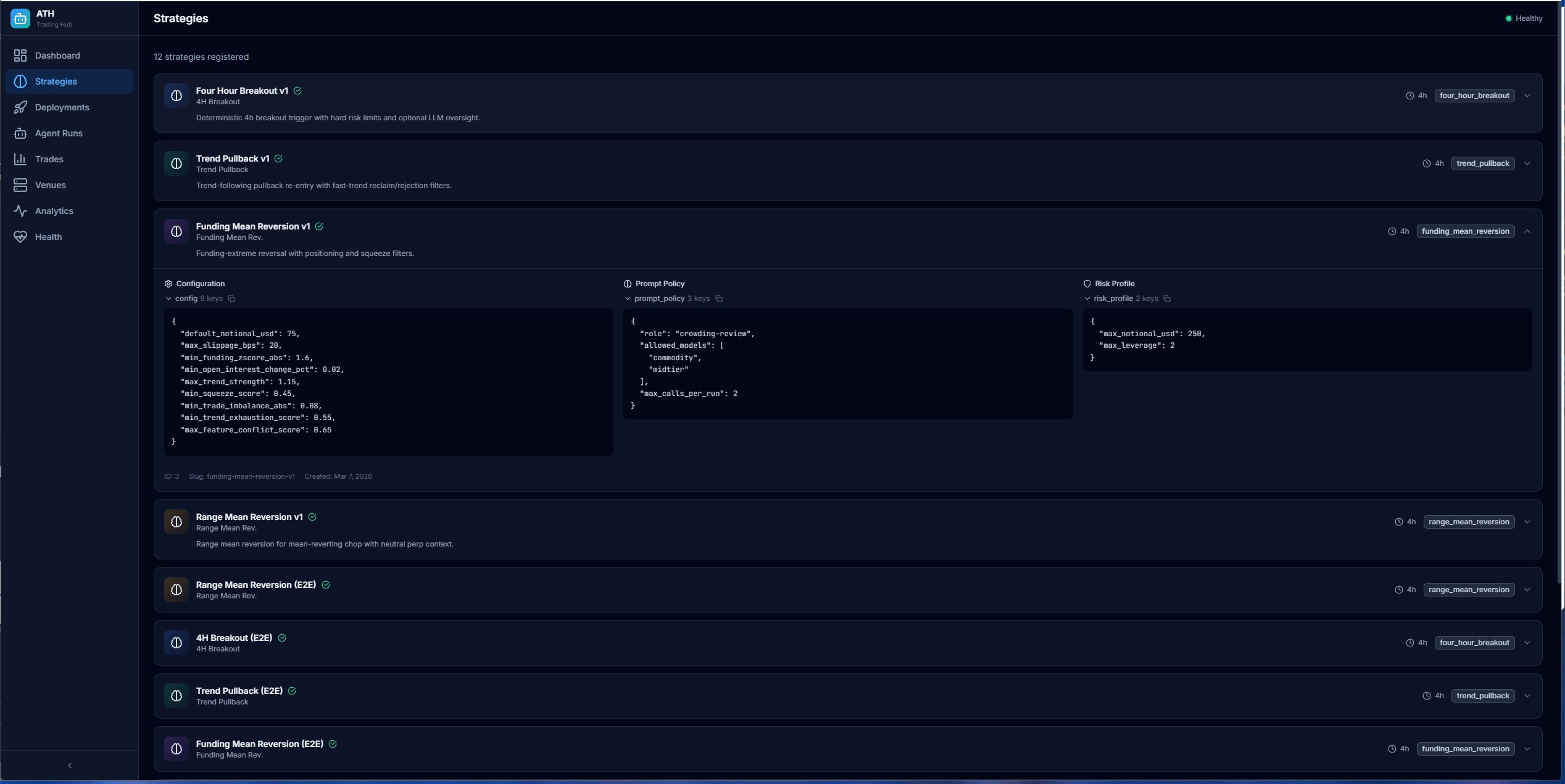 Strategy CatalogClick to view full size
Trading Strategies
10 deterministic strategies with configurable parameters, regime awareness, and multi-timeframe alignment.
Strategies are deterministic — AI adjusts sizing and timing, never the signal logic.
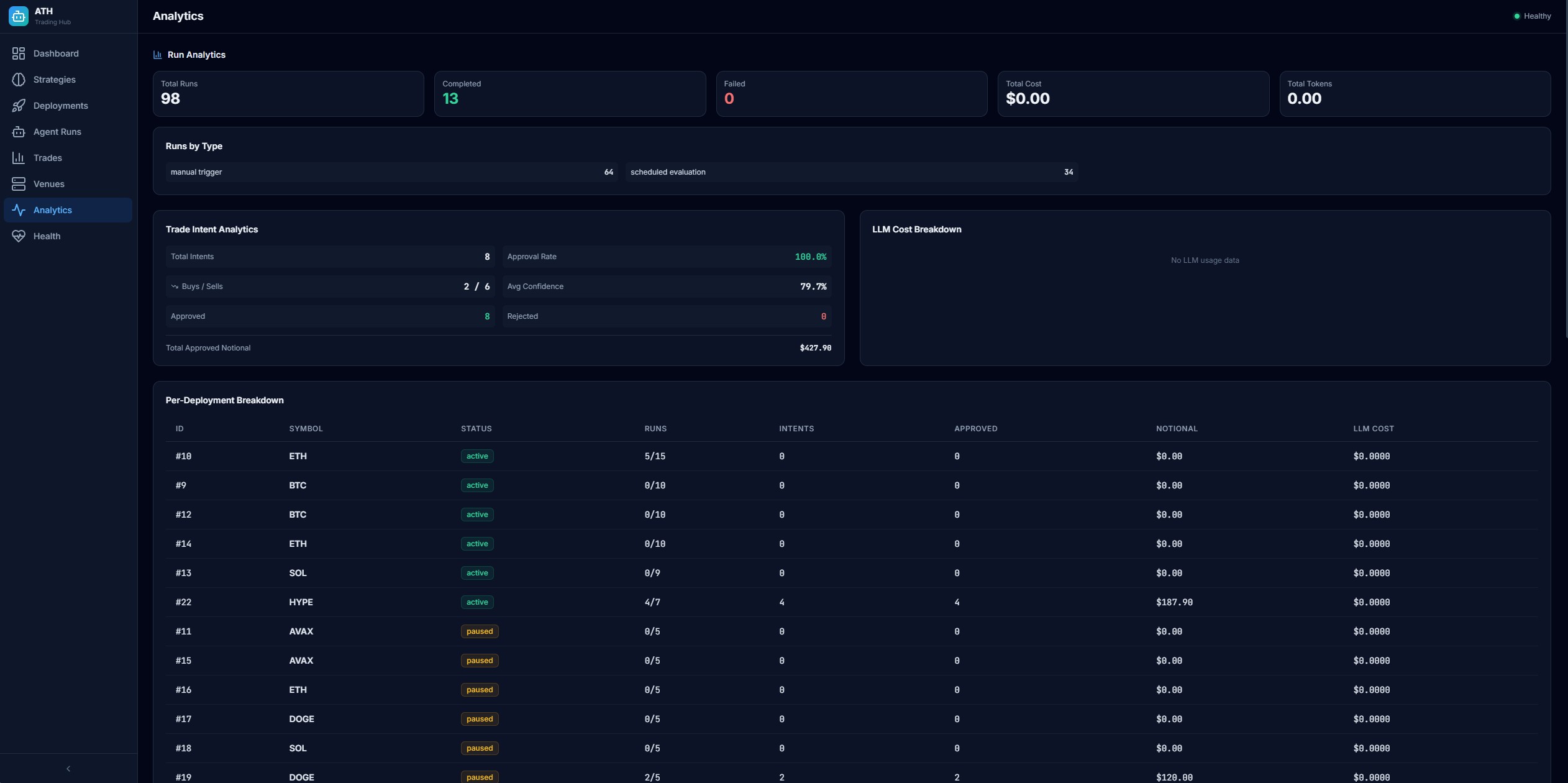 AI ObservabilityClick to view full size
Agent Analytics
Per-agent decision breakdowns, confidence calibration, cost tracking, and consensus agreement metrics.
Every LLM invocation is tracked: tokens, latency, cost, and decision outcome.
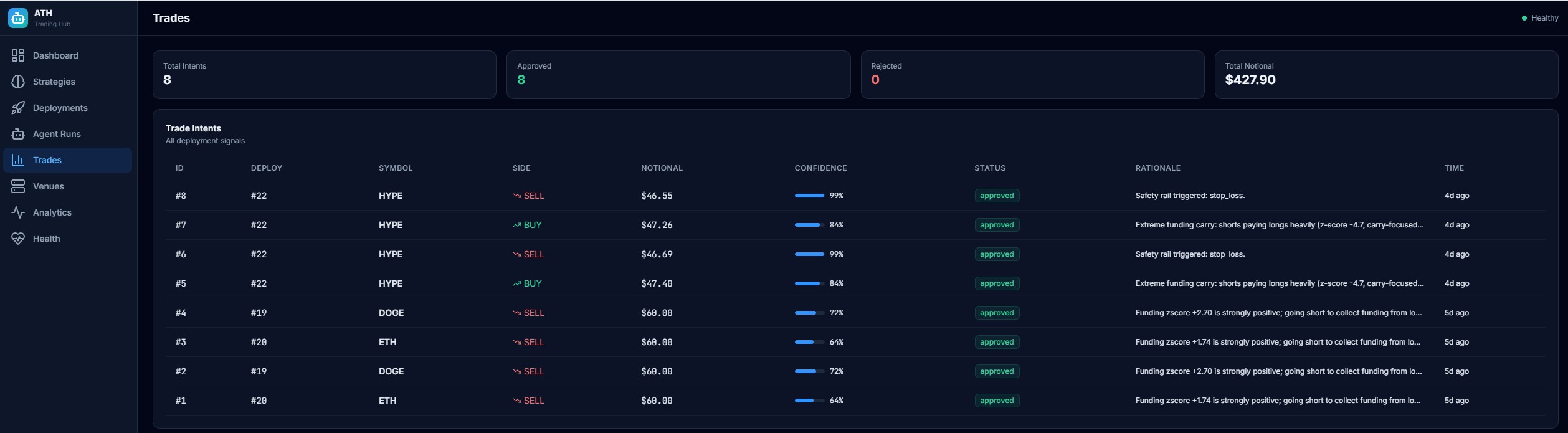 Execution LogClick to view full size
Trade History
Full trade lifecycle: intent → order → fill → P&L with regime labels and strategy attribution.
Post-trade review feeds back into the confidence store for future calibration.
Decisions
Tradeoffs that shaped the product
The strongest work is visible in the choices made under pressure, not just in the final interface.
Deterministic signals + AI sizing over fully autonomous agents
Challenge
LLMs hallucinate. Letting AI generate raw trading signals introduces unpredictable risk.
Decision
Strategies produce deterministic signals. AI agents can approve, veto, or adjust position size (0.5x–2.0x) — but never override the signal direction or entry logic.
Tradeoff
Limits the AI's freedom, but ensures every trade has a reproducible, auditable origin.
Multi-agent consensus over single-model decisions
Challenge
Any single LLM can have blind spots, model drift, or temporary degradation.
Decision
A Consensus Engine aggregates votes from 2+ LLMs with capability-weighted scoring (Claude Opus: 1.0, Haiku: 0.65, etc.). Agreement scores gate execution confidence.
Tradeoff
Higher latency and cost per decision, but significantly more robust risk assessment.
Temporal workflows over simple cron jobs
Challenge
Trading pipelines have multi-step dependencies with failure modes at each stage.
Decision
Temporal provides durable workflow orchestration with automatic retries, state persistence, and visibility into every step of the evaluation pipeline.
Tradeoff
Adds infrastructure complexity, but eliminates silent failures and provides full auditability.
Architecture
How data flows through the system
Market Snapshot
Live mid-prices, funding rates, L2 books, and 50+ features are computed across 5 timeframes (1h, 4h, daily, weekly, monthly) from Hyperliquid and Finnhub news.
→ A complete, multi-timeframe market context ready for strategy evaluation.
Strategy Signal
The deployed strategy (e.g., 4h breakout, funding arbitrage) evaluates the snapshot and produces a deterministic signal: action, confidence, desired notional, and entry/stop/TP levels.
→ A reproducible, auditable trade proposal with no AI dependency.
AI Review & Consensus
The Trade Planner selects strategies and sizes positions. The Analyst reviews for risk flags and regime mismatches. The Consensus Engine aggregates multi-model votes with capability weighting.
→ An AI-adjusted trade plan with bounded sizing (0.5x–2.0x) and consensus confidence.
Risk Engine
Hard gates check notional caps, leverage limits, daily P&L loss caps, slippage estimates from L2 books, and cooldown windows. The SafetyController applies drawdown throttling and volatility targeting.
→ A risk verdict — approved with scale factor, or rejected with reason.
Execution & Reconciliation
Approved trades are submitted to Hyperliquid via the SDK (or simulated in paper mode). A reconciliation loop verifies positions every 5 minutes. Post-trade review feeds confidence calibration.
→ Atomic execution with continuous state reconciliation against live exchange.
Agentic Trading Hub uses a layered architecture: FastAPI serves the API and orchestrates evaluation pipelines via Temporal durable workflows. Market data flows from Hyperliquid REST/WebSocket and Finnhub into a feature store with 50+ computed features. Deterministic strategies produce signals that flow through a 3-layer AI review (Planner → Analyst → Consensus), then through a 12-gate risk engine, before reaching the execution layer. PostgreSQL stores all trades, deployments, and market data. Redis handles caching and decision stores. Qdrant provides semantic memory for similar trade pattern matching. The React operator console provides full visibility into every step.
Product surfaces
The interfaces that carry the experience
Operator Console
React-based command center for managing deployments, monitoring agent decisions, reviewing trades, and tracking system health across all venues.
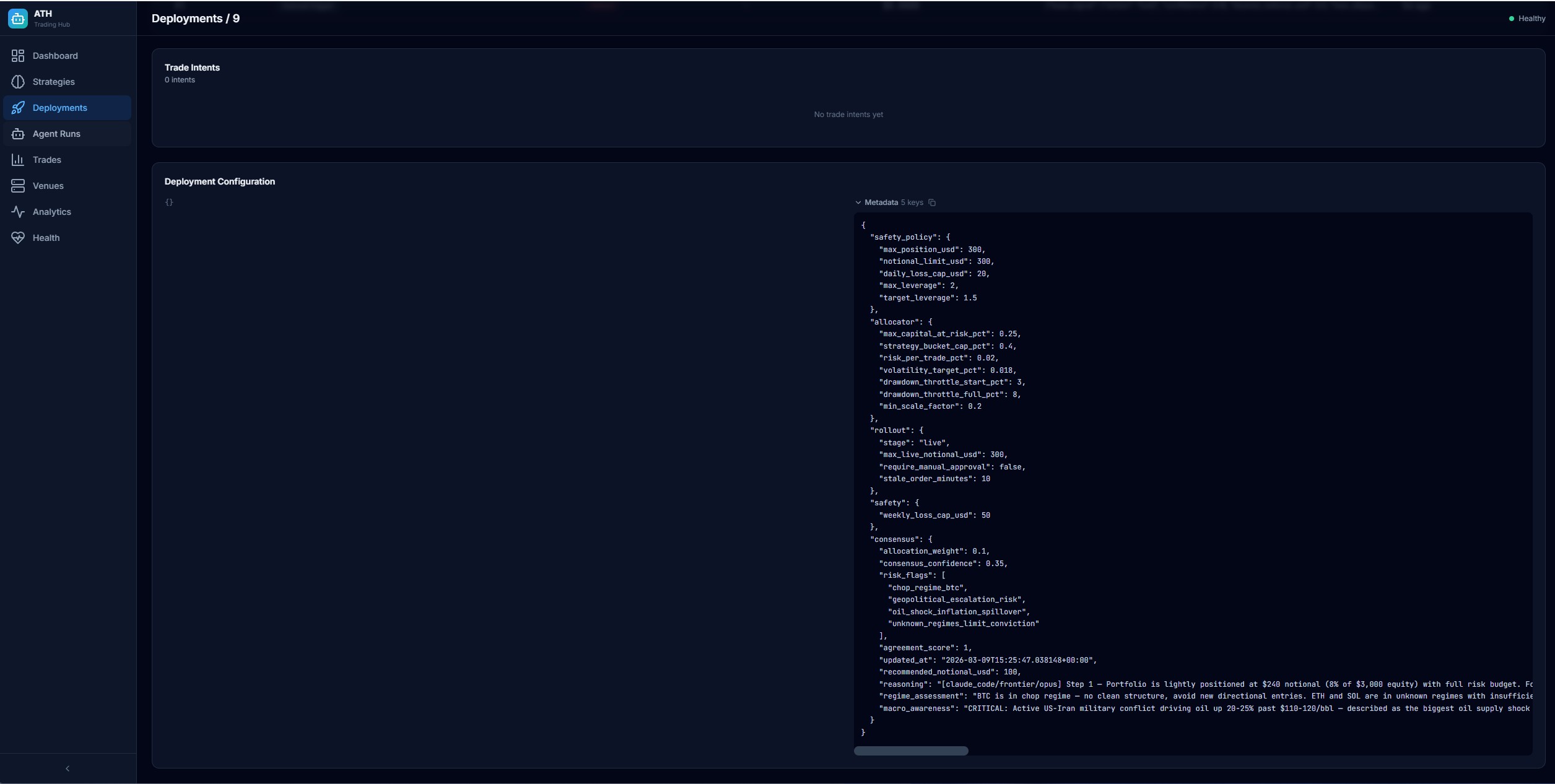
Strategy Deployments
Deploy any of 10 strategies to paper, shadow, or live mode with configurable budgets, schedules, risk parameters, and venue targeting.
AI Agent Pipeline
Three-layer AI architecture: Trade Planner for strategy selection, Analyst for risk review, and Consensus Engine for multi-model agreement scoring.
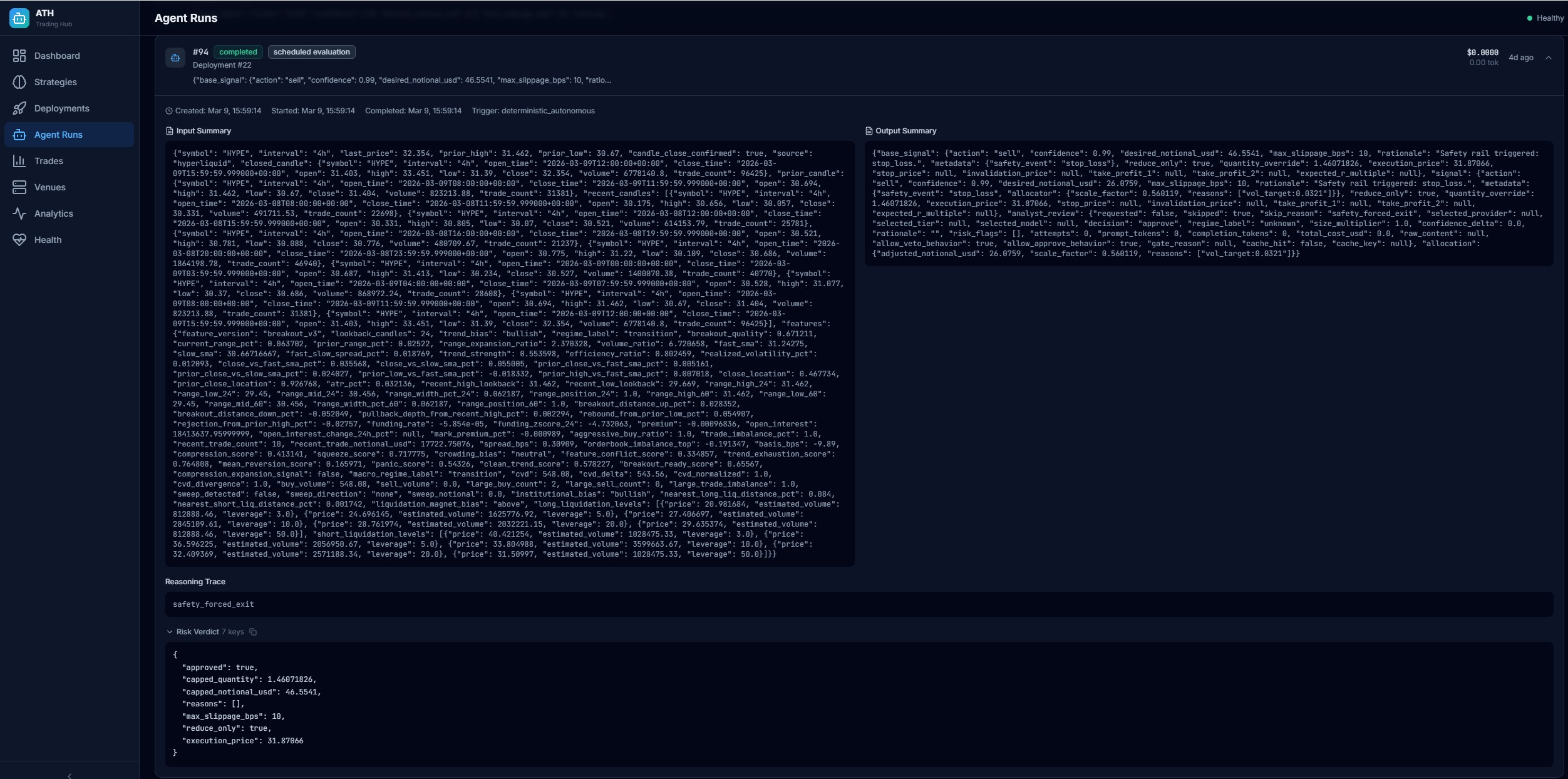
Live Sentiment Analysis
Finnhub news ingestion with relevance scoring against crypto keywords, headline deduplication, and integration with the AI planner for sentiment-aware positioning.
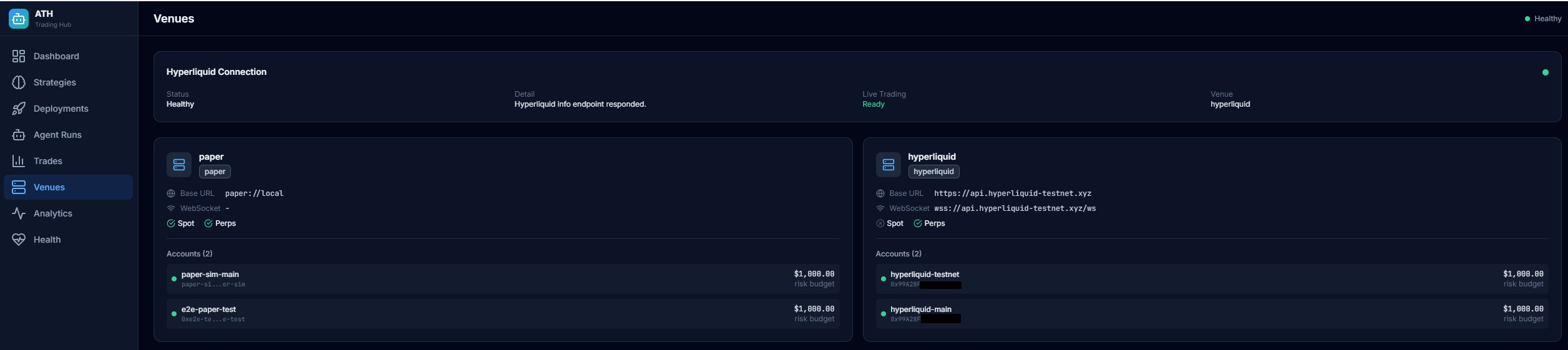
Hyperliquid Execution
Full SDK integration for order placement, cancellation, position tracking, mid-price feeds, L2 book access, and WebSocket orderflow — with paper trading simulator for development.
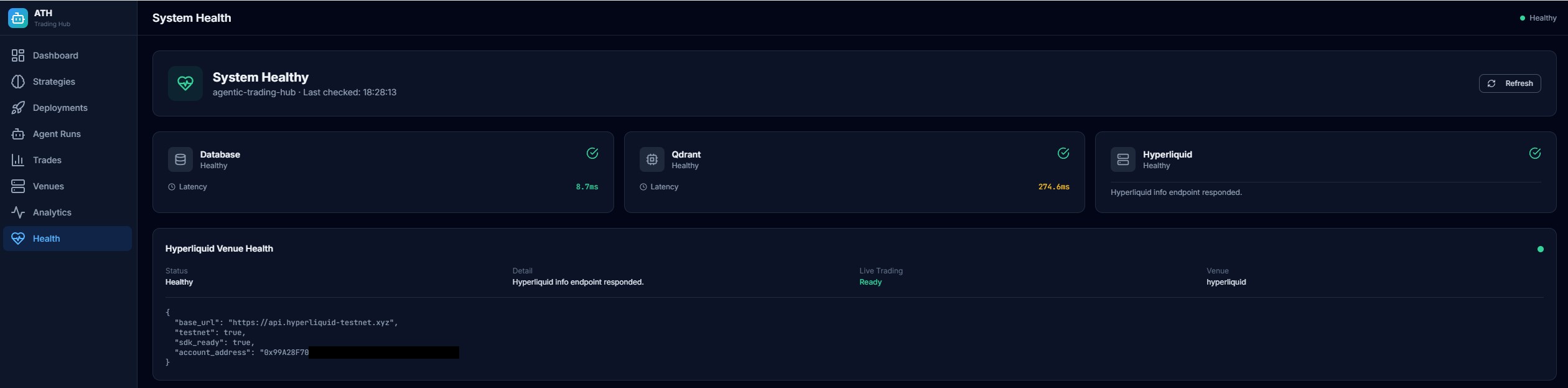
Risk Management
12-gate risk engine with hard guardrails (notional caps, leverage limits) and soft constraints (drawdown throttling, volatility targeting, Kelly-derived sizing).
Trade History & Review
Full trade lifecycle tracking from intent to fill with post-trade review, confidence calibration, and semantic memory storage in Qdrant for pattern matching.
10 Trading Strategies
Deterministic strategy library covering 4h breakout, trend pullback, funding mean reversion, funding arbitrage, OU mean reversion, liquidation cascade, entropy regime, and more.
Tech Stack
Built with

FastAPI
Async Python API and orchestration

PostgreSQL
Trades, deployments, market data

Redis
Cache, decision store, job queue
Framework
Data
UI
Web3
AI
Infra
Languages
PythonTypeScriptSQLWhat this project proves